Over the last decade, South Indian cinema has transformed from a regional powerhouse into a national and global force. Films that were once limited to Telugu, Tamil, Kannada, or Malayalam audiences are now breaking records across India and overseas markets.
From Baahubali to KGF, from Pushpa to RRR, South cinema has redefined what “Pan-India” truly means. But how did this shift happen? And what does it mean for Bollywood and the future of Indian entertainment?
Let’s break it down.
What Does “Pan-India” Really Mean?
The term “Pan-India film” refers to movies released simultaneously in multiple languages across the country, targeting a nationwide audience rather than a regional one.
Earlier, Bollywood dominated the Hindi-speaking belt while South films stayed regional. Today, that divide has almost disappeared.
A Telugu or Kannada film can now:
- Open strongly in Mumbai
- Collect massively in North India
- Trend on national OTT platforms
- Compete directly with Hindi releases
This is a major shift in the industry structure.
The Turning Point: Baahubali Phenomenon
The real turning point came with Baahubali: The Beginning (2015) and Baahubali 2 (2017).
Why Baahubali Worked:
- Grand scale storytelling
- Universal emotional themes
- High production value
- Strong marketing in Hindi belt
The sequel became one of the highest-grossing Indian films ever, proving that language is no longer a barrier.
This opened doors for future Pan-India projects.
Rise of Mass Action Spectacles
After Baahubali, several South films embraced large-scale action dramas:
- KGF Chapter 1 & 2
- Pushpa: The Rise
- RRR
- Kantara
These films combined:
- Hero-centric storytelling
- Powerful background scores
- Mass elevation scenes
- Strong emotional core
North Indian audiences connected deeply with this cinematic style.
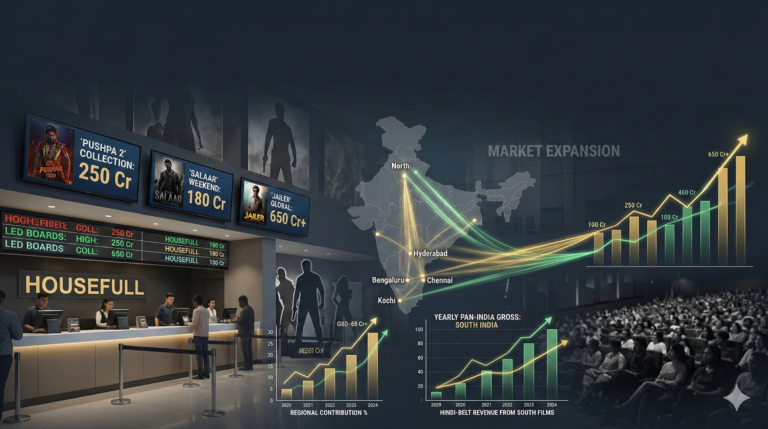
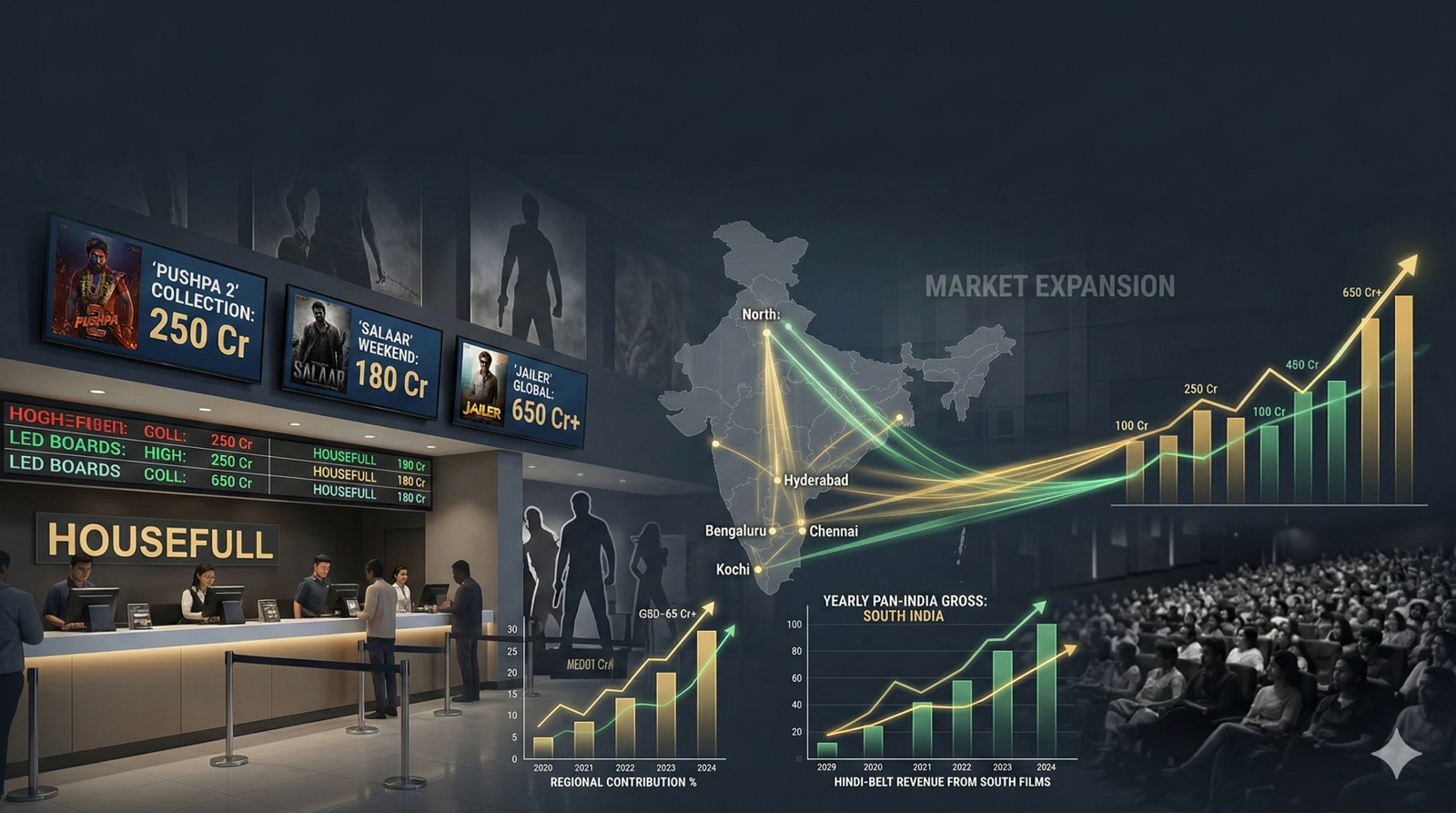
Box Office Numbers Tell the Story
Let’s look at the trend:
- KGF Chapter 2 collected massive numbers in Hindi belt
- Pushpa became a cultural phenomenon with dialogues and songs trending nationally
- RRR gained global recognition and even won international awards
Meanwhile, several big Bollywood films struggled during the same period.
This shift forced industry experts to rethink audience preferences.
Why South Cinema Is Dominating
1️⃣ Strong Storytelling Focus
South filmmakers often prioritize strong narratives and emotional arcs over urban glamour.
2️⃣ Director-Driven Cinema
Unlike Bollywood’s star-driven system, many South films are director-focused, with long-term vision and world-building.
3️⃣ Cultural Rootedness
Films like Kantara proved that rooted, local stories can become national successes when executed authentically.
4️⃣ Theatrical Experience Priority
South films emphasize larger-than-life theatrical moments, encouraging big-screen viewing — which boosts box office revenue.
Impact on Bollywood
The rise of South cinema has:
- Increased competition
- Changed audience expectations
- Forced Bollywood to rethink scripts
- Encouraged remakes (though many failed)
Interestingly, instead of remakes, audiences now prefer watching original South films dubbed in Hindi.
This marks a psychological shift in viewer mindset.
OTT Platforms & Pan-India Growth
Streaming platforms played a crucial role in expanding South cinema’s reach.
Dubbed versions on OTT helped:
- Introduce actors to national audiences
- Build pre-release hype
- Increase fanbase across regions
Now, actors like Allu Arjun, Yash, Prabhas, and Jr NTR enjoy nationwide popularity.
Are We Seeing a Permanent Shift?
The big question is: Is this dominance temporary or permanent?
Analysis
It’s not about one industry replacing another. Instead, it’s about integration.
Indian cinema is becoming more unified. Language barriers are fading. Content quality is now the biggest factor.
Bollywood is adapting by:
- Investing in large-scale action films
- Exploring rooted storytelling
- Collaborating with South directors
The competition may ultimately benefit audiences.
Opinion: It’s the Era of Content Over Language
The success of South cinema proves one thing clearly — audiences care about engaging storytelling more than language.
If a film connects emotionally, delivers strong performances, and offers theatrical spectacle, it will succeed nationwide.
Rather than a “South vs Bollywood” debate, this should be seen as a transformation phase for Indian cinema as a whole.
What This Means for the Future
Going forward, we can expect:
- More multi-language releases
- Bigger budgets
- Cross-industry collaborations
- Nationwide marketing strategies
The Pan-India model is here to stay.
FAQs
1. What is a Pan-India film?
A Pan-India film is released simultaneously in multiple languages across India to target a national audience.
2. Which film started the Pan-India trend?
Baahubali is widely considered the turning point for Pan-India success.
3. Why are South films performing better than some Bollywood films?
Strong storytelling, large-scale action, and rooted narratives have resonated more with audiences recently.
4. Is Bollywood declining?
Not necessarily. The industry is evolving and adapting to changing audience expectations.
5. Will this trend continue?
Given current market patterns, the Pan-India model is likely to remain strong in the coming years.
Conclusion
South cinema’s rise in the Pan-India market is not just a trend — it’s a structural shift in Indian entertainment. With massive box office numbers, global recognition, and nationwide fanbases, South films have reshaped industry dynamics.
As Indian cinema moves toward integration rather than division, audiences stand to gain the most from this creative competition.