
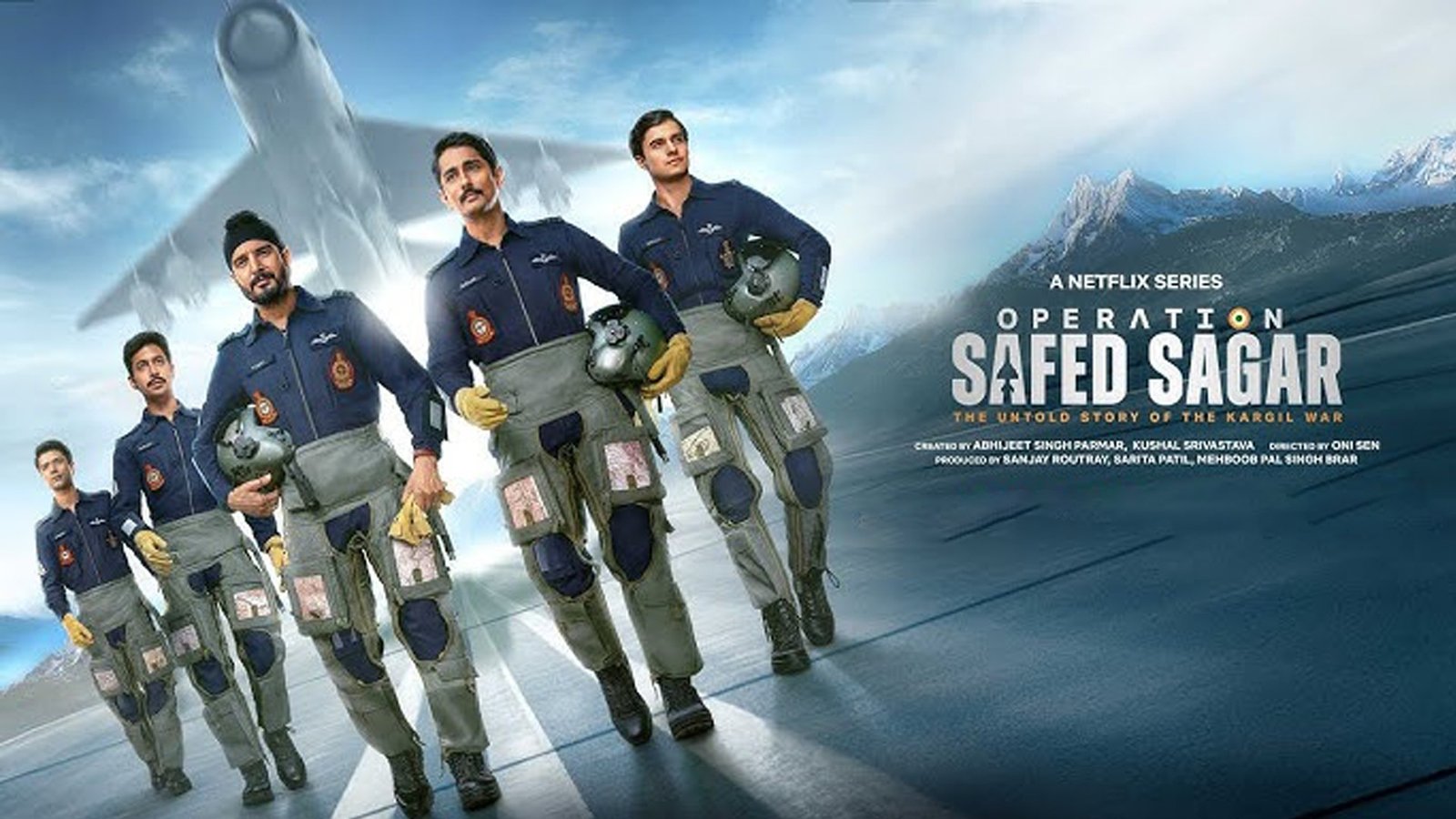
Netflix is set to bring one of India’s most significant military operations to the screen with Operation Safed Sagar. Led by Siddharth and Jimmy Shergill, the upcoming series is inspired by the Indian Air Force’s crucial role during the 1999 Kargil War. Here’s the real story behind the mission that changed the course of the conflict.
Operation Safed Sagar Real Story: How the IAF Helped Turn the Tide in the Kargil War
As India gears up to celebrate Independence Day, Netflix is preparing to premiere Operation Safed Sagar, a series based on one of the Indian Air Force’s most important military campaigns. Featuring Siddharth, Jimmy Shergill, Abhay Verma, Mihir Ahuja, Taaruk Raina, and Arnav Bhasin, the series revisits the courage and challenges faced by the IAF during the 1999 Kargil War.
Created by Abhijeet Singh Parmar and Kushal Srivastava, and directed by Oni Sen, the show is inspired by real events that played a crucial role in India’s victory.
What Was Operation Safed Sagar?
Operation Safed Sagar was the codename given to the Indian Air Force’s air campaign during the Kargil War in 1999. The operation was launched in support of the Indian Army’s Operation Vijay after Pakistani soldiers and armed infiltrators occupied strategic mountain positions on the Indian side of the Line of Control (LoC).
The intrusion took place across key sectors, including Kargil, Drass, Batalik, and Mushkoh, threatening India’s control over vital mountain regions.
The operation marked the first large-scale deployment of Indian air power in Kashmir since the 1971 Indo-Pak war and is widely regarded as one of the most challenging high-altitude air campaigns ever undertaken.
Why the Mission Became Necessary
During the early months of 1999, Indian patrols discovered that Pakistani troops, supported by armed infiltrators, had taken control of several high-altitude posts that Indian forces usually vacated during the harsh winter.
These positions overlooked National Highway 1A, the strategic road connecting Srinagar to Leh. Control over these heights posed a serious threat to India’s military supply routes and complicated the Army’s efforts to regain lost territory.
As the scale of the intrusion became clear, the Indian government authorised the Air Force to join the operation. Operation Safed Sagar officially began on May 26, 1999.
The Indian Air Force’s Role in the Kargil War
The IAF was tasked with targeting enemy bunkers, ammunition depots, supply routes, and logistics bases while providing crucial air support to Indian Army units fighting uphill under extremely difficult conditions.
One important restriction remained in place throughout the campaign: Indian aircraft were instructed not to cross the Line of Control under any circumstances.
Despite this limitation, the Air Force carried out precision strikes that significantly weakened enemy positions and supported the Army’s advance.

The Challenges Pilots Faced
Flying combat missions above 15,000 feet presented extraordinary challenges. Thin air reduced aircraft performance, affected engine efficiency, and made accurate targeting far more difficult than in conventional combat.
The danger increased further because enemy forces were equipped with shoulder-fired surface-to-air missiles.
During the early phase of the campaign, Squadron Leader Ajay Ahuja’s MiG-21 was shot down on May 27, 1999. An IAF MiG-27 was also lost due to engine trouble during combat operations.
Flight Lieutenant K. Nachiketa ejected safely after his aircraft went down and was later repatriated to India. In another setback, an Mi-17 helicopter was brought down by a Stinger missile.
How the Mission Changed the War
Following the initial losses, the Indian Air Force adapted its strategy by shifting to higher-altitude bombing missions and deploying its Mirage 2000 fighter aircraft.
The Mirage fleet successfully carried out precision attacks on several important Pakistani supply camps, including the Muntho Dhalo logistics base.
These strikes disrupted enemy supply lines, weakened fortified positions, and helped the Indian Army reclaim strategic peaks such as Tiger Hill and Tololing, which proved decisive in the outcome of the war.
India’s Victory and the End of the Operation
Operation Safed Sagar concluded alongside Operation Vijay after Indian forces regained control of the occupied positions.
Facing sustained military pressure and increasing international diplomatic pressure, Pakistan eventually withdrew its forces, bringing the conflict to an end.
The operation remains one of the Indian Air Force’s most significant combat achievements and is remembered for its precision, courage, and coordination with ground forces.
When Will Operation Safed Sagar Release on Netflix?
Netflix’s Operation Safed Sagar premieres August 7, 2026. According to the makers, the series has been filmed at operational Indian Air Force bases and features real MiG fighter aircraft along with active IAF personnel, aiming to deliver an authentic portrayal of the historic mission.
With its focus on real events and military history, the series promises to offer viewers a closer look at one of the defining chapters of the Kargil War.