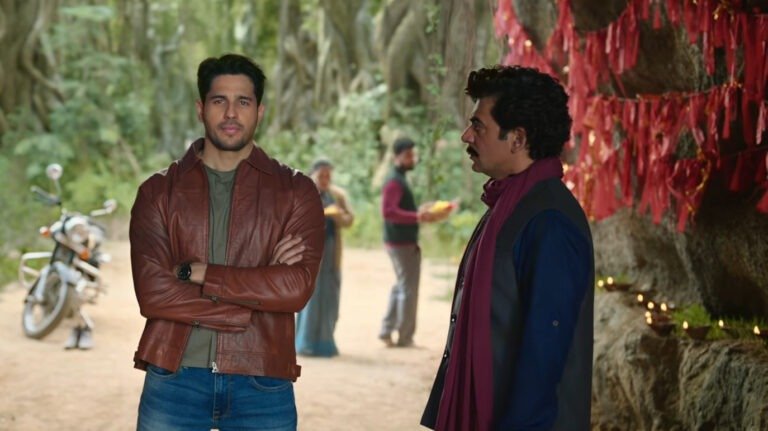

Sunny Deol returns to the courtroom with Ikka, a commercial legal drama that blends morality, suspense, and emotional conflict. Directed by Siddharth P. Malhotra, the film poses an intriguing question: Can a lawyer defend someone he believes is guilty? While the premise is compelling and the performances are strong, the screenplay ultimately favors commercial heroism over legal realism.
Story
Ikka follows Arjun Mehra (Sunny Deol), Mumbai’s most respected criminal defense lawyer, known for representing only clients he believes are innocent.
His principles are tested when he is forced to defend Shauryamann Gaur (Akshaye Khanna), the privileged son of an influential businessman accused of sexually assaulting and attempting to murder a young woman.
Although Arjun is convinced his client is hiding the truth, a deeply personal crisis leaves him with no choice but to take the case.
Standing against him is determined public prosecutor Madhura Banerjee (Tillotama Shome), who believes the evidence clearly points to Shauryamann’s guilt.
As the trial unfolds, new evidence, conflicting testimonies, and unexpected twists blur the line between truth and perception, forcing everyone inside the courtroom to question their assumptions.
Rather than functioning as a conventional courtroom mystery, Ikka explores whether a lawyer’s responsibility lies in uncovering the truth or ensuring every accused person receives the strongest possible legal defense.
Performances
Sunny Deol delivers one of his most restrained performances in recent years.
Instead of relying entirely on his trademark larger-than-life courtroom persona, he portrays Arjun Mehra with quiet conviction and emotional vulnerability. His internal struggle between professional ethics and personal responsibility gives the character emotional weight. While the screenplay eventually allows him familiar heroic moments, it is the quieter family scenes that leave a stronger impact.
Akshaye Khanna is the film’s standout performer.
As Shauryamann Gaur, he creates an unsettling presence through subtle expressions and controlled dialogue delivery. The character remains unpredictable throughout much of the narrative, keeping audiences guessing about his true intentions. Although some of Khanna’s familiar acting mannerisms begin to feel repetitive, his performance remains one of the film’s biggest strengths.
Tillotama Shome is excellent as prosecutor Madhura Banerjee.
She brings intelligence and dignity to the courtroom proceedings, making her confrontations with Sunny Deol among the film’s best sequences. Unfortunately, the screenplay gradually sidelines her character as the focus shifts toward the hero.
Dia Mirza and Sanjeeda Shaikh perform well despite receiving limited screen time.
Analysis
Ikka distinguishes itself from many recent courtroom dramas through its central moral dilemma.
Instead of asking whether the accused committed the crime, it explores whether a lawyer should defend someone he personally believes may be guilty. That ethical conflict provides the film with a fascinating foundation.
Director Siddharth P. Malhotra approaches the material as a mainstream commercial entertainer rather than a realistic legal drama.
This is not the restrained courtroom realism of films like Jai Bhim or Section 375. Instead, Ikka embraces dramatic confrontations, emotional speeches, and larger-than-life hero moments reminiscent of classic Bollywood courtroom dramas.
Initially, the screenplay does an excellent job maintaining uncertainty around Shauryamann’s guilt. Every witness statement and piece of evidence invites audiences to reconsider what they believe. Arjun’s internal conflict becomes more compelling than the legal battle itself.
Unfortunately, the screenplay gradually abandons this psychological complexity.
The second half increasingly depends on conveniently timed evidence and dramatic twists designed more to surprise viewers than organically develop the investigation. While several twists remain entertaining, they often feel engineered rather than earned.
The courtroom arguments themselves are similarly inconsistent. Some hearings generate genuine tension, but others rely heavily on emotional speeches instead of persuasive legal reasoning. The screenplay repeatedly tells viewers that Arjun is an exceptional lawyer without consistently demonstrating the brilliance behind his courtroom victories.
One of the film’s biggest missed opportunities is Tillotama Shome’s character.
She is introduced as a capable legal opponent, yet gradually becomes reactive as the narrative shifts toward elevating Sunny Deol’s heroism. A more balanced courtroom battle between two equally intelligent lawyers would have significantly strengthened the film.
Similarly, Dia Mirza’s character is given far less emotional development than the story demands.
Ultimately, Ikka succeeds as an entertaining commercial courtroom thriller but falls short of becoming a truly great legal drama. Its performances, premise, and emotional core remain engaging, even if the screenplay repeatedly chooses spectacle over subtle storytelling.
Music And Technical Aspects
The background score effectively supports the film’s commercial tone, especially during major courtroom confrontations and dramatic reveals.
Editing keeps the proceedings reasonably engaging despite a lengthy runtime, although the second half could have benefited from tighter pacing.
The cinematography and production design create a polished courtroom setting without becoming distracting.
Highlights
- Akshaye Khanna’s performance
- Sunny Deol’s restrained acting
- Strong central premise
- Engaging first half
- Moral conflict at the heart of the story
Drawbacks
- Uneven screenplay
- Overly convenient twists
- Inconsistent courtroom writing
- Weak dialogue in places
- Second-half pacing issues
Final Verdict
Ikka may not redefine the courtroom thriller genre, but it delivers enough entertainment through its compelling premise and strong lead performances. Sunny Deol and Akshaye Khanna carry the film effectively, even when the screenplay begins to lose its grip. Viewers looking for a commercial courtroom drama with emotional stakes and engaging performances are likely to find enough to enjoy.